
By Dr. Neha Rai, Consultant Neurosurgeon
Hydrocephalus is a build-up of cerebrospinal fluid (CSF) in the spaces deep inside the brain, called ventricles. The extra fluid makes the ventricles larger and puts pressure on the brain, which is why the condition is often described as “water on the brain”. The fluid is not plain water, but cerebrospinal fluid that normally cushions and protects the brain.
Hydrocephalus can happen at any age, but it is more common in infants and in adults aged 60 and older . Without treatment it usually gets worse and can cause serious harm, yet surgery can drain the extra fluid and control the pressure, and many people do well when it is found and treated early.
In this guide, Dr. Neha Rai explains the types, symptoms and causes of hydrocephalus, how it is diagnosed, how shunt surgery and endoscopic third ventriculostomy work, and when to see a doctor.
What Is Hydrocephalus?
Cerebrospinal fluid is made by tissue lining the ventricles. It flows through the brain’s inner spaces, moves around the brain and spinal cord, and is then absorbed by blood vessels in the outer layer of the brain [1]. This fluid helps the brain float, cushions it from sudden movements, carries away waste and helps control pressure inside the skull [1].
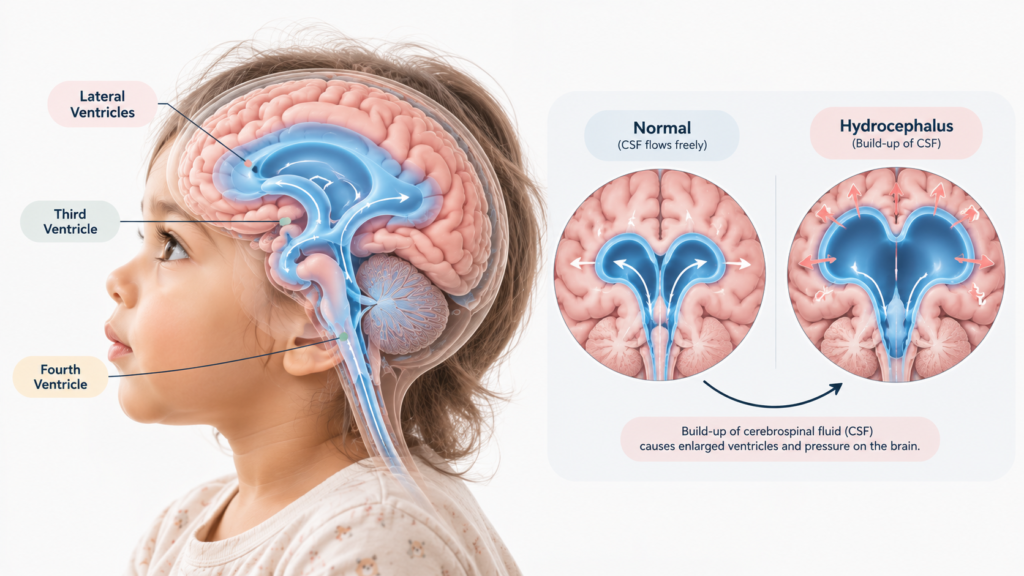
Hydrocephalus happens when there is a problem with how this fluid is made, moved or absorbed. Too much fluid builds up for one of three reasons [1,3]:
- Blocked flow: this is the most common cause. Something slows or stops the fluid between the ventricles, or between the ventricles and the spaces around the brain.
- Trouble absorbing fluid: this is less common and usually follows swelling or inflammation from an illness or injury.
- Making too much fluid: this is rare and is usually caused by a tumor in the area that produces the fluid.
What Are the Types of Hydrocephalus?
Doctors describe hydrocephalus in several ways, depending on when it starts and how the fluid is affected [1,5]:
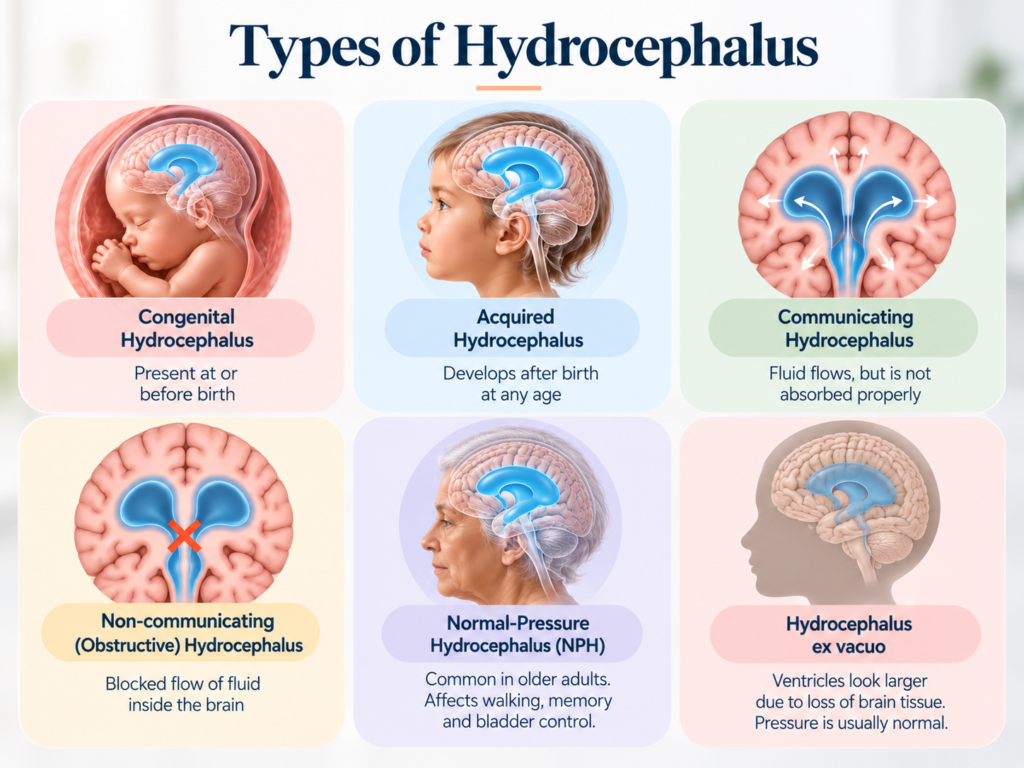
- Congenital hydrocephalus is present at or before birth. It can occur when the brain does not develop as expected in the womb, or because of changes in genes.
- Acquired hydrocephalus develops after birth, at any age, often after an infection, bleeding, tumor or injury.
- Communicating hydrocephalus: fluid flows through the ventricles without being blocked, but the body does not absorb it properly or makes too much.
- Non-communicating (obstructive) hydrocephalus: something blocks the flow of fluid inside the brain, so the ventricles behind the blockage get bigger and pressure inside the skull rises.
- Normal-pressure hydrocephalus (NPH): most common in older adults. The ventricles enlarge, but the fluid pressure stays within a typical range. It can affect walking, memory and bladder control.
- Hydrocephalus ex vacuo: this happens after brain tissue is lost, for example after a stroke or head injury. The ventricles look larger because the brain has shrunk, but the pressure is usually normal.
What Are the Symptoms of Hydrocephalus?
The symptoms of hydrocephalus depend on the person’s age and on how quickly the fluid builds up [1].

Infants
- A head that is larger than usual, or that grows rapidly
- A bulging or tense soft spot (fontanelle) on top of the head
- Vomiting
- Sleepiness or sluggishness
- Irritability and poor feeding
- Seizures
- Eyes fixed downward (“sunsetting” of the eyes)
- Problems with muscle tone and strength
Toddlers and Older Children
- Headache, nausea and vomiting
- Blurred or double vision, or unusual eye movements
- Sleepiness or tiredness
- Trouble with balance and poor coordination
- Poor appetite
- Loss of bladder control or needing to urinate often
- Irritability, personality changes, or a decline in school performance
- Delays or difficulty with skills already learned, such as walking or talking
Young and Middle-Aged Adults
- Headache and sluggishness
- Loss of coordination or balance
- Vision problems
- Loss of bladder control or needing to urinate often
- Decline in memory, concentration and other thinking skills that may affect work
Older Adults and Normal-Pressure Hydrocephalus
In adults aged 60 and older, the more common symptoms are trouble walking, often described as shuffling or the feet feeling “stuck”, poor balance, memory loss, slowing of thinking and loss of bladder control [1]. Because these symptoms come on slowly and resemble dementia and Alzheimer’s disease, normal-pressure hydrocephalus is often missed. It matters to get the diagnosis right, because unlike Alzheimer’s disease, the symptoms of NPH can improve with treatment [5].
Seek emergency medical care for an infant or toddler with a high-pitched cry, trouble sucking or feeding, repeated vomiting with no clear cause, or seizures [1]. Call 112 or go to the nearest hospital.
What Causes Hydrocephalus?
In many cases the cause is not clear. When a cause is found, it usually falls into one of two groups [1,3].
In newborns (congenital hydrocephalus)
- Development of the central nervous system in a way that blocks the flow of fluid. Children born with spina bifida often develop hydrocephalus [3].
- Bleeding inside the brain, which can be a complication of premature birth [1,3].
- Infections in the womb during pregnancy, such as rubella or syphilis, which can cause swelling in the baby’s brain tissue [1].
At any age (acquired hydrocephalus)
- Brain or spinal cord tumors
- Infections of the brain or its coverings, such as meningitis or mumps
- Bleeding in the brain caused by a stroke or head injury
- Other brain injuries that affect how fluid flows or is absorbed
Having hydrocephalus does not mean a person will develop a brain tumor, and a child with hydrocephalus does not always have spina bifida [3].
How Is Hydrocephalus Diagnosed?
Diagnosis is usually based on the person’s symptoms, a general physical exam, a neurological exam and brain imaging [2]. In babies, doctors also track the size of the head over time, and a steadily increasing head size is often the first sign [3].
Imaging tests help confirm hydrocephalus and look for its cause [2,3,4]:
- Ultrasound: often the first test in infants, because it is simple and low-risk.
- MRI: shows enlarged ventricles caused by extra fluid and gives the most detail about the cause.
- CT scan: quick and widely available, and often used in emergencies. It shows less detail than MRI and uses a small amount of radiation.
For suspected normal-pressure hydrocephalus, doctors also assess how the person walks, their thinking and memory, and their bladder symptoms [5].
How Is Hydrocephalus Treated?
All treatments for hydrocephalus aim to reduce pressure inside the head, either by diverting the fluid away from the brain or by restoring its normal flow [4]. The best option depends on the cause, the person’s age and the scan findings, and the neurosurgeon will explain which one suits the patient [3,4].
Shunt Surgery
A shunt is a thin tube that is permanently placed under the skin to drain extra fluid from the brain to another part of the body, where it is absorbed [4]. It contains a valve that controls how fast the fluid drains [3,4]. Depending on where the fluid is drained, a shunt may be [4]:
- Ventriculo-peritoneal (VP) shunt: drains into the abdomen. This is the most common type.
- Ventriculo-atrial (VA) shunt: drains into a blood vessel leading to the heart.
- Ventriculo-pleural shunt: drains into the space beside the lung.
Some adults may have a lumbar shunt, which drains fluid from around the spinal cord in the lower back [4]. Some valves have a fixed setting, while others are adjustable after surgery using a special magnet [4].
Shunt surgery is done under general anaesthesia, with one small cut on the head and another where the tube will drain. The tube is tunneled under the skin between the two [3,4]. Hospital stays are usually short, often a few days [3,4].
Endoscopic Third Ventriculostomy (ETV)
In some people, the brain’s fluid channels are blocked inside the brain. In these cases, a neurosurgeon may be able to create a new pathway for the fluid using a fine camera-tube called a neuro-endoscope, so no implant is needed [4]. This operation is also done under general anaesthesia.
The advantage of ETV is that it can provide a long-lasting solution without a shunt. However, it is not suitable for everyone. Whether it is possible is decided by the neurosurgeon after studying the scans, and even then a shunt may still be needed. In some people the new opening closes over time, and the symptoms return [4].
Shunt Complications and Warning Signs
A shunt is a man-made device, so it can block, get infected or drain too much. It can last from a few weeks to many years, and may need to be replaced at some point [4]. Families and patients should know the warning signs.
A blocked or malfunctioning shunt may cause [3,4]:
- Headache, nausea and vomiting
- Drowsiness or difficulty waking
- Swelling around the shunt valve
- Return of the symptoms that were present before the shunt, such as balance problems or worsening memory
- A change in seizure pattern, if the person has epilepsy
- In babies: a bulging soft spot, irritability, pale skin and increasing head size
A shunt infection is most likely in the first few months after surgery, and the risk is highest in the first 30 days. Warning signs include fever, headache, irritability, neck stiffness, feeling unwell, and redness, swelling or fluid leaking from the wound [3,4]. Treatment usually needs antibiotics and removal of the infected shunt, often with a temporary external drain, before a new shunt is placed [3,4].
Draining too much fluid (low pressure) can cause severe headache, vomiting, paleness and sweating, usually when the person is upright. In babies the soft spot may look sunken [3].
Get urgent medical help (call 112 or go to the nearest hospital) if a person with a shunt has repeated vomiting, severe headache, drowsiness, fever or a bulging soft spot. Tell the doctors you have a shunt [3,4].
Other risks of any hydrocephalus surgery include bleeding, and rarely brain injury or seizures. The surgeon should explain these before the operation [4].
Living With Hydrocephalus
Hydrocephalus usually needs long-term follow-up, even after successful surgery, so that a blocked shunt or a closed ETV opening can be picked up early [4]. People with shunts can usually go to school and work and take part in most sports. Boxing is not advised because of repeated head injury, and extra caution is needed with activities such as scuba diving [4]. If a person with a shunt has a head injury, they should tell the doctors treating them that they have a shunt. People with an adjustable valve may be advised to avoid close contact with strong magnets and handheld security scanners, which can change the valve setting [4].
If hydrocephalus is not treated, it can cause learning difficulties, developmental delay and physical disabilities, and it can be life-threatening. Children who are treated early and followed up regularly often do much better, so it is worth acting early [1,3].
Can Hydrocephalus Be Prevented?
Hydrocephalus cannot always be prevented, but some steps can lower the risk [1]:
- Attend regular antenatal check-ups, which help find infections and reduce the risk of premature birth.
- Get vaccinated against rubella before pregnancy and avoid infections during pregnancy.
- Ask your doctor about meningitis vaccination for your child.
- Protect the head with car seats, helmets and seat belts.
- Get infections such as meningitis or encephalitis treated quickly.
- Look after your general health, including blood pressure, since strokes and tumors can lead to hydrocephalus.
When Should You See a Doctor?
Seek prompt medical attention for any symptom of hydrocephalus, at any age [1]. See a doctor without delay if:
- A baby’s head is growing very fast, or the soft spot is bulging
- A child has repeated headaches or vomiting, new vision problems, or a drop in school performance
- An adult has new problems with balance or walking along with memory changes or bladder problems
- An older adult is slowly developing walking trouble, memory loss and bladder problems, which should not simply be put down to age
More than one condition can cause these symptoms, so a proper evaluation matters [1].
Frequently Asked Questions About Hydrocephalus
Is hydrocephalus the same as “water on the brain”?
Yes. “Water on the brain” is an everyday name for hydrocephalus. The fluid involved is cerebrospinal fluid, not water [1].
Can hydrocephalus be cured?
Surgery can control hydrocephalus and relieve its symptoms by draining the extra fluid. However, shunts can block or wear out over time, so most people need long-term follow-up and some need repeat surgery [4].
Can adults get hydrocephalus?
Yes. Hydrocephalus can develop at any age, and it is more common in infants and in adults aged 60 and older [1].
Is normal-pressure hydrocephalus the same as dementia?
No. NPH can look like dementia or Alzheimer’s disease, but it is a different condition, and its symptoms can improve with treatment, which is why a correct diagnosis is important [5].
Can hydrocephalus go away on its own?
Hydrocephalus usually gets worse over time if it is not treated, so symptoms should not be ignored [1].
Can a person with a shunt live a normal life?
Many people with shunts live active lives, going to school and work and taking part in most sports, as long as they have regular follow-up and know the warning signs of a shunt problem [4].
Conclusion
Hydrocephalus is a treatable condition, but it needs prompt attention. Recognizing the warning signs, such as a rapidly growing head in a baby, repeated headaches and vomiting in a child, or walking and memory problems in an adult, can lead to earlier treatment and better outcomes.
If you or your child has symptoms of hydrocephalus, or if you have a shunt and are worried it may not be working, book a consultation with Dr. Neha Rai for a proper evaluation.
This article is for general patient education and does not replace medical advice.
References
- Mayo Clinic. Hydrocephalus: Symptoms and causes. Updated March 17, 2026. https://www.mayoclinic.org/diseases-conditions/hydrocephalus/symptoms-causes/syc-20373604
- Mayo Clinic Health Information Library. Hydrocephalus: Diagnosis. https://www.kuh.ku.edu.tr/mayo-clinic-care-network/mayo-clinic-health-information-library/diseases-conditions/hydrocephalus
- Great Ormond Street Hospital for Children NHS Foundation Trust. Hydrocephalus. https://www.gosh.nhs.uk/conditions-and-treatments/conditions-we-treat-index-page-group/hydrocephalus
- University Hospital Southampton NHS Foundation Trust. Adult hydrocephalus and shunts: Information for patients. https://www.uhs.nhs.uk/Media/UHS-website-2019/Patientinformation/Brain-and-spine/Adult-hydrocephalus-and-shunts-1520-PIL.pdf
- NI Direct (NHS information). Hydrocephalus. https://nidirect.gov.uk/node/12051