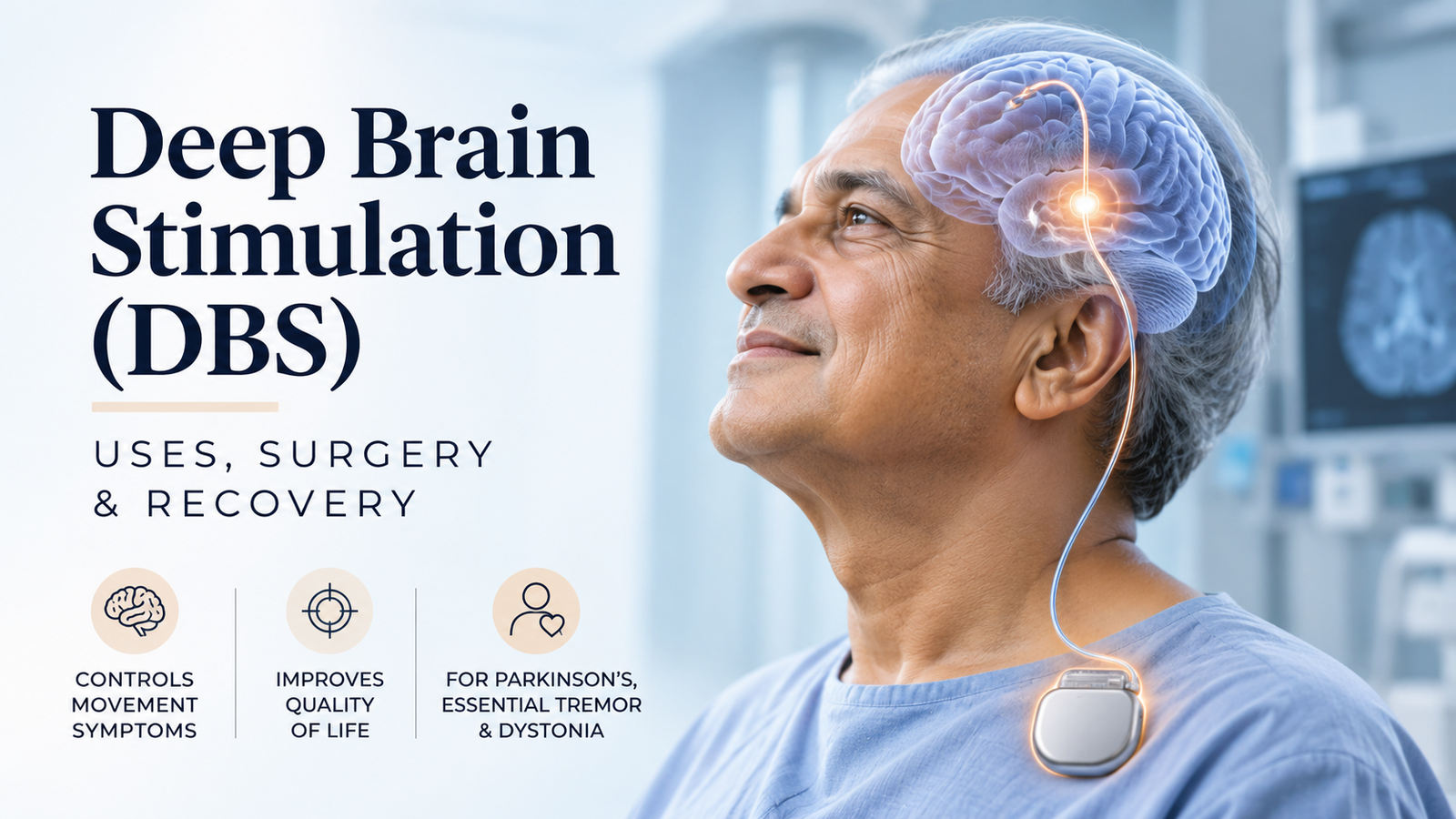
Deep brain stimulation (DBS) is an advanced surgical treatment that may help people with certain movement disorders, including Parkinson’s disease, essential tremor and dystonia. Medicines help many people manage these symptoms. However, some patients continue to experience disabling symptoms or troublesome medication-related fluctuations despite appropriate treatment. Healthcare providers may offer deep brain stimulation (DBS) to carefully selected patients.
Deep brain stimulation is a surgical treatment that uses controlled electrical impulses to influence specific brain circuits involved in movement. It can improve certain symptoms of conditions such as Parkinson’s disease, essential tremor and dystonia. DBS is not a cure, does not stop an underlying neurological condition from progressing, and is not suitable for everyone.
In this guide, Dr. Neha Rai explains what DBS is, which conditions it may help, how doctors assess suitability, what happens during surgery and what patients should know about recovery and long-term care.
What Is Deep Brain Stimulation (DBS)?
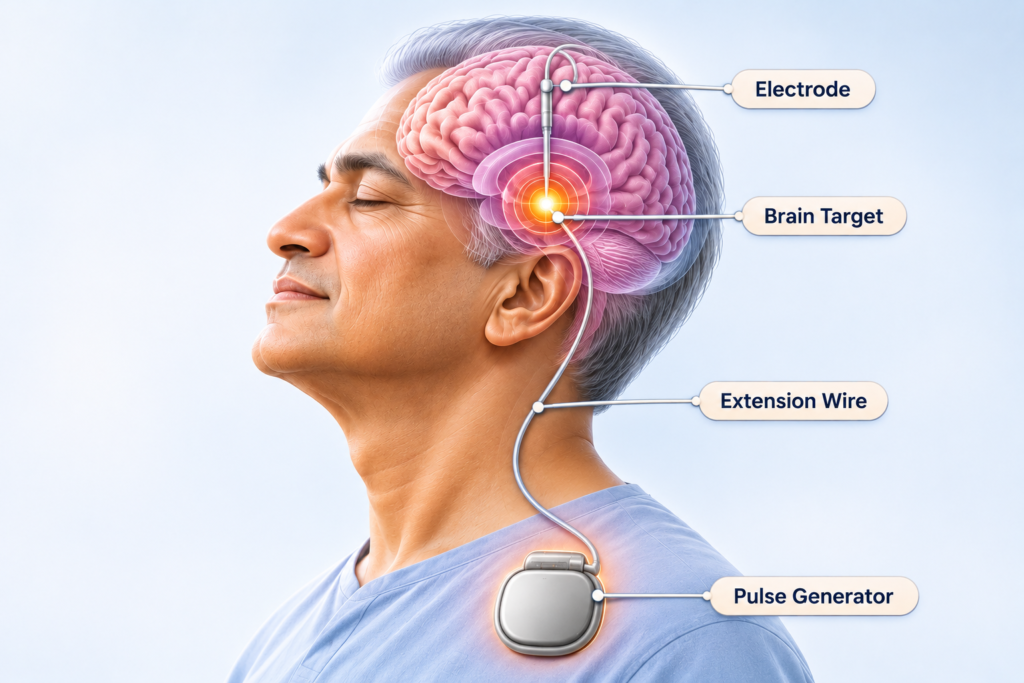
Deep brain stimulation, or DBS, involves placing thin insulated wires, leads or electrodes, into carefully selected brain areas. The leads connect to an implanted pulse generator, a small battery-powered device usually placed under the skin near the chest. The generator sends electrical pulses through the leads to influence activity in the brain circuits involved in movement.
Clinicians can adjust the stimulation settings after surgery. We call this process programming, and it plays an important role in the treatment. The clinician determines the precise brain target based on the condition, the symptoms treated, and the patient’s individual assessment.
People sometimes describe Deep Brain Stimulation as a brain pacemaker. However, it is a specialized, programmable therapy that modulates selected brain networks. The exact way it produces symptom improvement is still being studied.
Which Conditions Can Deep Brain Stimulation Help?
DBS is an established treatment option for selected movement disorders. Whether it is appropriate depends on the diagnosis, symptom pattern, response to medication, overall health and treatment goals.
Parkinson’s disease
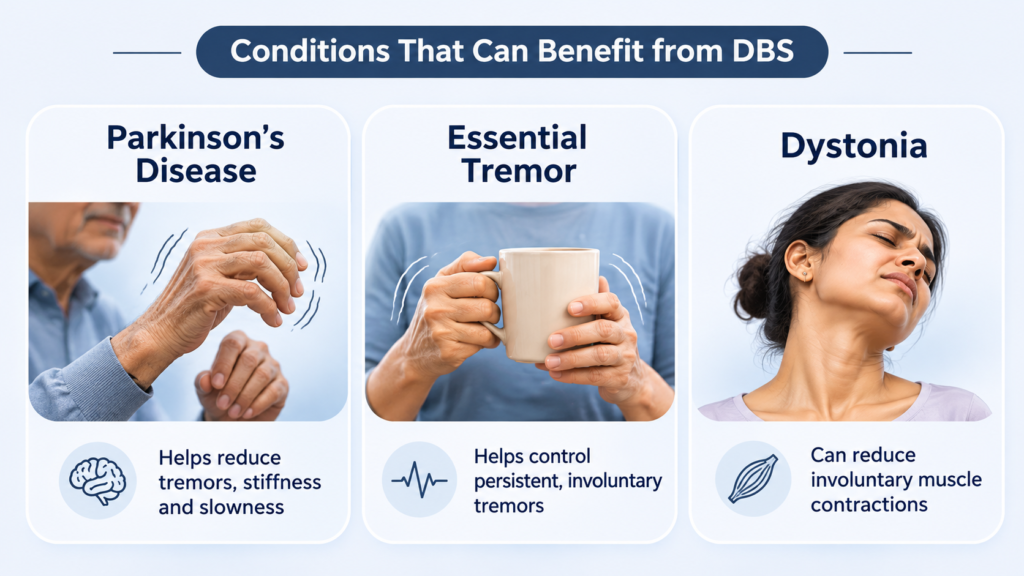
For some people with Parkinson’s disease, DBS can reduce disabling motor symptoms such as tremor, stiffness and slowness of movement. It may also help with motor fluctuations, when symptoms return before the next medication dose, and dyskinesia, which refers to involuntary movements that can occur in people taking Parkinson’s medication.
Doctors typically recommend DBS when troublesome symptoms or medication-related complications persist despite careful medical management. It does not treat every feature of Parkinson’s disease equally. Problems such as balance difficulties, speech changes, freezing of gait, memory problems and other non-motor symptoms may respond less reliably. Many patients continue to need medication after surgery.
Essential tremor
Essential tremor can cause involuntary shaking, often affecting the hands and sometimes the head or voice. When tremor is severe, it may interfere with eating, drinking, writing or other daily tasks. If medication does not provide adequate relief or causes adverse side effects, clinicians may consider DBS for selected patients.
Dystonia
Dystonia causes involuntary muscle contractions that can lead to twisting movements, repetitive motions or abnormal postures. DBS may help certain types of dystonia, but results vary according to its cause, pattern and duration. Improvement may develop gradually over weeks or months, rather than immediately after surgery.
DBS is also used in specialist settings for selected other conditions, but it should not be assumed to be appropriate for every neurological or psychiatric disorder. The evidence, approvals and selection criteria differ by condition.
Who May Be a Candidate for Deep Brain Stimulation?
Having Parkinson’s disease, tremor or dystonia does not automatically mean someone needs DBS. A movement-disorder specialist and neurosurgical team assess whether the expected benefits are likely to outweigh the risks.
The assessment may include:
- Confirming the diagnosis and reviewing how symptoms have changed over time.
- Reviewing current and previous medicines, including how symptoms respond to treatment.
- Assessing how symptoms affect daily activities, independence and quality of life.
- A detailed neurological examination and, when appropriate, standardized movement assessments.
- Brain imaging, such as MRI or CT, to help plan surgery and assess suitability.
- Cognitive, memory and mood assessment when indicated.
- A discussion with the patient and family about realistic goals, possible limitations and long-term follow-up.
For Parkinson’s disease, a response to levodopa can help doctors estimate which movement symptoms may improve with DBS, although it is not the only factor in deciding suitability. Significant cognitive impairment, unstable psychiatric symptoms, serious medical problems or symptoms unlikely to respond to stimulation may affect the decision. Age or disease duration alone should not determine candidacy.
How do surgeons carry out deep brain stimulation surgery?
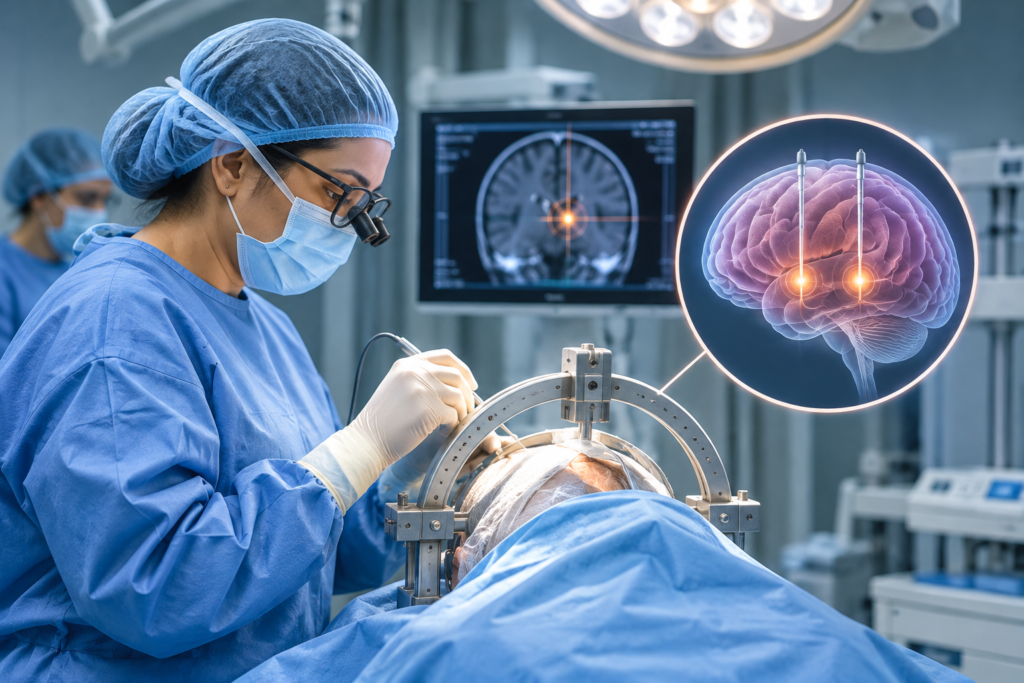
DBS surgery involves placing electrodes in selected brain targets and connecting them to an implanted pulse generator. The exact technique varies according to the patient’s needs, the device and the treating centre. Brain imaging and specialized planning tools help the neurosurgeon identify the intended target.
- Pre-operative planning: The team reviews the diagnosis, symptoms, medical history and brain scans to select an appropriate target and plan the procedure.
- Electrode placement: The neurosurgeon places one or more thin electrodes into the selected brain area through a small opening in the skull. Depending on the plan and the centre, surgery may be performed while the patient is awake, under general anaesthesia, or using a combination of approaches.
- Connecting the device: The electrodes are connected to extension wires that run under the skin to the pulse generator, usually implanted near the chest.
- Initial recovery: The patient is monitored after surgery. The team provides instructions about wound care, activity, medicines and follow-up.
- Device programming: The stimulator is activated and adjusted, often after an initial healing period. Several appointments may be needed to find settings that provide a useful balance between symptom relief and side effects.
Some centres complete electrode placement and pulse-generator implantation in one operation, while others stage the procedures. The surgical team will explain the approach planned for each patient.
What Are the Potential Benefits of Deep Brain Stimulation?
For appropriately selected patients, DBS may provide meaningful improvement in specific movement symptoms and daily functioning. Potential benefits include:
- Reduced tremor, stiffness, slowness or other targeted movement symptoms.
- Fewer or shorter periods when Parkinson’s symptoms return between medication doses, in some patients.
- Reduced medication-related dyskinesia in selected people with Parkinson’s disease.
- Improved ability to carry out particular daily activities affected by the treated symptoms.
- Adjustable stimulation settings that can be reviewed and modified over time.
The degree of improvement varies. DBS does not cure Parkinson’s disease or other underlying conditions, and it does not prevent their progression. Some symptoms may not improve, even when the procedure successfully treats the symptoms targeted by the device.
What Are the Risks and Possible Side Effects?
DBS involves brain surgery and an implanted medical device, so it carries risks. The treating team should explain the risks that apply to the patient’s health and planned procedure. Possible complications include:
- Bleeding in or around the brain, including a risk of stroke.
- Infection involving the surgical wound or implanted device.
- Seizures, which are uncommon but possible.
- Pain, swelling, headache or discomfort around the incision or device site.
- Changes in speech, balance, walking, sensation, mood or thinking, which may be related to stimulation or surgery.
- Device-related problems, such as lead movement, wire damage, skin erosion or battery depletion, which may require further treatment or surgery.
Some stimulation-related side effects can improve when the device settings are adjusted. However, not every side effect can be fully reversed or corrected. Patients should contact their treating team if they develop new or worsening symptoms after surgery.
Recovery and Life After DBS
Recovery time varies depending on the procedure, general health and individual circumstances. Patients receive instructions about wound care, activity, medicines and follow-up. It is important to attend scheduled appointments, even when symptoms improve.
DBS is an ongoing treatment rather than a one-time operation with no further care. Programming visits allow the team to adjust stimulation settings as needed. Medication is often continued, although some patients may be able to change their doses under medical supervision.
Patients should tell every healthcare professional that they have an implanted DBS system. Precautions for MRI scans and other medical procedures depend on the exact device model and its manufacturer’s conditions. Do not assume that every scanner or procedure is safe with every DBS system. Ask the DBS team before undergoing imaging, surgery or other treatments.
The care team can also advise when it is appropriate to return to driving, work, exercise, travel and other activities. These recommendations are individual and should not be based on another patient’s recovery experience.
DBS and Medication: Do They Replace Each Other?
DBS and medication are not necessarily alternatives. Medicines remain an important part of treatment for Parkinson’s disease and many movement disorders. DBS may be added when symptoms or medication-related complications are not adequately controlled, despite appropriate treatment.
Some patients are able to reduce certain medicines after DBS, but many continue taking medication. The decision depends on the condition, symptoms, response to stimulation and overall treatment plan. Medicines should never be stopped or changed without guidance from the treating clinician.
When Should You Discuss DBS With a Specialist?
A specialist review may be useful when a diagnosed movement disorder continues to interfere with daily life despite appropriate treatment. You may wish to discuss advanced treatment options if you experience:
- Tremor that makes eating, drinking, writing or other routine tasks difficult.
- Parkinson’s symptoms that return before the next scheduled medication dose.
- Involuntary movements that may be related to Parkinson’s medication.
- Stiffness or slowness that remains disabling despite treatment adjustments.
- Dystonia or another movement disorder that is not responding adequately to standard treatment.
A consultation does not imply that DBS surgery will be recommended. It helps the specialist review the diagnosis, treatment response, goals, benefits, limitations and risks, and decide whether a formal DBS assessment is appropriate.
Frequently Asked Questions About Deep Brain Stimulation
Is deep brain stimulation a cure for Parkinson’s disease?
No. DBS can improve selected movement symptoms in suitable patients, but it does not cure Parkinson’s disease or stop its progression. Medication and ongoing specialist care are usually still needed.
Is the patient awake during DBS surgery?
It depends on the surgical plan and the centre. The neurosurgical team performs some procedures while the patient is awake, while other procedures use general anaesthesia. The neurosurgical team will explain the approach recommended for the individual.
Will I still need medicines after DBS?
Many patients continue taking medication after surgery. Some may be able to adjust their doses, but this varies. The treating clinician should make medication changes.
How long does a DBS battery last?
Battery life depends on the type of pulse generator, stimulation settings and how frequently it is used. Some systems have rechargeable batteries, while others need replacement when the battery runs down. The DBS team can explain the maintenance needs of the specific device.
Can DBS help every type of tremor?
No. DBS may help selected tremor conditions, including essential tremor and some Parkinson’s-related tremor. Shaking can have many causes, so an accurate diagnosis is necessary before treatment options are considered.
Is DBS surgery safe?
DBS is an established treatment for selected movement disorders, but it is not risk-free. It involves brain surgery and an implanted device. A detailed assessment helps determine whether the potential benefits justify the risks for an individual patient.
Conclusion
Deep brain stimulation can be an important treatment option for selected people living with Parkinson’s disease, essential tremor and certain forms of dystonia when symptoms remain difficult to manage. The procedure uses implanted electrodes and a programmable device to influence specific brain circuits. Careful patient selection, experienced surgical care, programming and long-term follow-up are essential parts of treatment.
If tremor, stiffness or involuntary movements are affecting your daily life, speak with a movement-disorder specialist about the available treatment options and whether a DBS assessment may be appropriate.
Medical Disclaimer
This article is for general educational purposes only and is not a substitute for individual medical advice, diagnosis or treatment. Suitability for DBS and treatment outcomes vary from person to person. Please consult a qualified neurologist and neurosurgical team to discuss your condition and treatment options.
References
- National Institute of Neurological Disorders and Stroke (NINDS). Deep Brain Stimulation (DBS). https://www.ninds.nih.gov/health-information/disorders/deep-brain-stimulation-dbs
- Parkinson’s Foundation. Deep Brain Stimulation (DBS). https://www.parkinson.org/living-with-parkinsons/treatment/surgical-treatment-options/deep-brain-stimulation
- Parkinson’s Foundation. Considering Deep Brain Stimulation. https://www.parkinson.org/library/fact-sheets/deep-brain-stimulation
- American Association of Neurological Surgeons (AANS). Deep Brain Stimulation. https://www.aans.org/patients/conditions-treatments/deep-brain-stimulation/
- MedlinePlus. Deep Brain Stimulation. https://medlineplus.gov/ency/article/007453.htm
- National Institute of Mental Health (NIMH). Brain Stimulation Therapies. https://www.nimh.nih.gov/health/topics/brain-stimulation-therapies/brain-stimulation-therapies