Cerebral palsy is a group of conditions that affect movement, balance and posture, and it is the most common motor disability in childhood. It is caused by abnormal development of, or damage to, the developing brain, and the symptoms usually appear in infancy or early childhood .
The condition looks very different from one child to another. One child may walk a little awkwardly and need no special help, while another may need equipment or lifelong care. The brain changes behind cerebral palsy do not get worse over time, although the symptoms can change as a child grows.
In this guide, Dr. Neha Rai explains the symptoms, types, causes and risk factors of cerebral palsy, how it is diagnosed and treated, and when to speak to a doctor.
What Is Cerebral Palsy?
“Cerebral” refers to the brain, and “palsy” refers to weakness or problems with using the muscles. Cerebral palsy (CP) happens when the part of the brain that controls muscles does not develop as expected, or is damaged early in life, so a child has difficulty controlling movement, posture and balance.
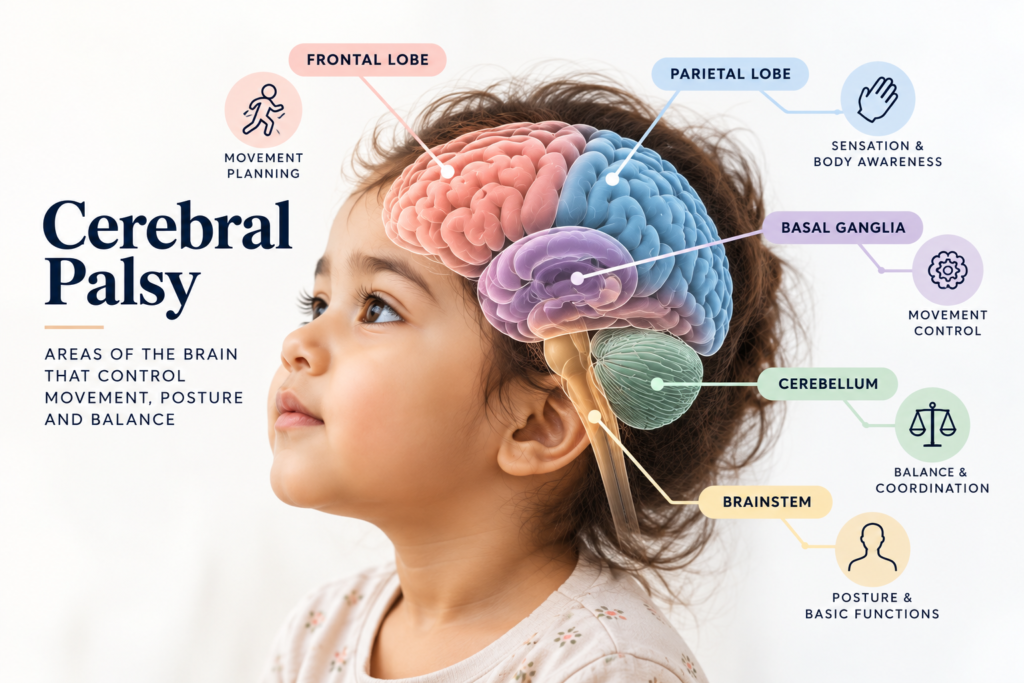
There is currently no cure for cerebral palsy. However, therapy, medicines, surgery and supportive devices can improve a child’s abilities, and starting treatment early gives children a better chance of overcoming developmental difficulties.
What Are the Symptoms of Cerebral Palsy?
The main sign that a child may have cerebral palsy is a delay in reaching movement milestones such as rolling over, sitting, standing or walking . The symptoms are often not obvious just after birth and become clearer over the first months and years .
Movement and Posture Problems
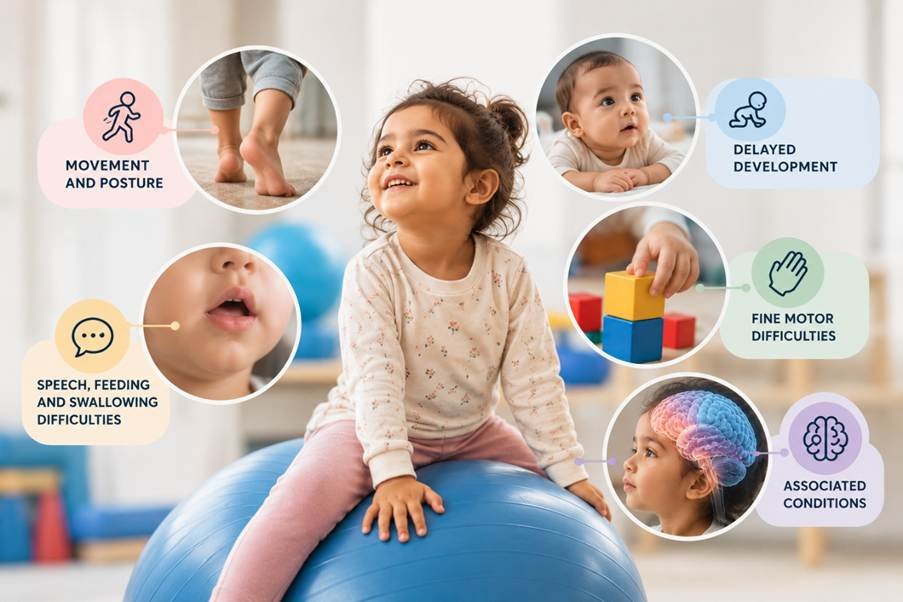
All people with cerebral palsy have some problem with movement and posture. These may include:
- Stiff muscles and exaggerated reflexes (spasticity)
- Muscle tone that is too stiff or too floppy
- Poor balance and coordination (ataxia)
- Tremor or involuntary movements
- Weakness in one or more arms or legs
- An unusual walk, such as walking on the toes, a crouched gait or a “scissored” gait with the knees crossing
- Difficulty with fine motor tasks such as writing or buttoning a shirt
Early Signs of Cerebral Palsy in Babies
The signs below do not always mean cerebral palsy, but they are worth discussing with your child’s doctor :
- Younger than 6 months: the head lags when the baby is picked up lying on the back, the body feels stiff or floppy, or the legs stiffen and cross or scissor when the baby is lifted.
- Older than 6 months: the baby does not roll over in either direction, cannot bring the hands together or to the mouth, or reaches out with only one hand while the other stays in a fist.
- Older than 10 months: the baby crawls in a lopsided way, pushing with one hand and leg while dragging the other, or scoots on the buttocks or hops on the knees instead of crawling on all fours.
Speech, Feeding and Swallowing Difficulties
Some children have delayed speech or trouble speaking. They may also have difficulty sucking, chewing or swallowing, and may drool [1]. Swallowing problems can make it hard to get enough nutrition, so they should be assessed early.
Other Conditions That Can Occur With Cerebral Palsy
Many children also have related problems, although not every child has all of them [1,2,3]:
- Intellectual or learning difficulties
- Seizures (epilepsy)
- Problems with vision or hearing
- Curving of the spine (scoliosis) and tight, shortened muscles (contractures)
- Delayed growth
- Bladder and bowel problems
Important: If these signs appear suddenly, treat it as an emergency and call 112, because sudden weakness, face drooping or trouble speaking can be signs of stroke rather than cerebral palsy [3].
What Are the Types of Cerebral Palsy?
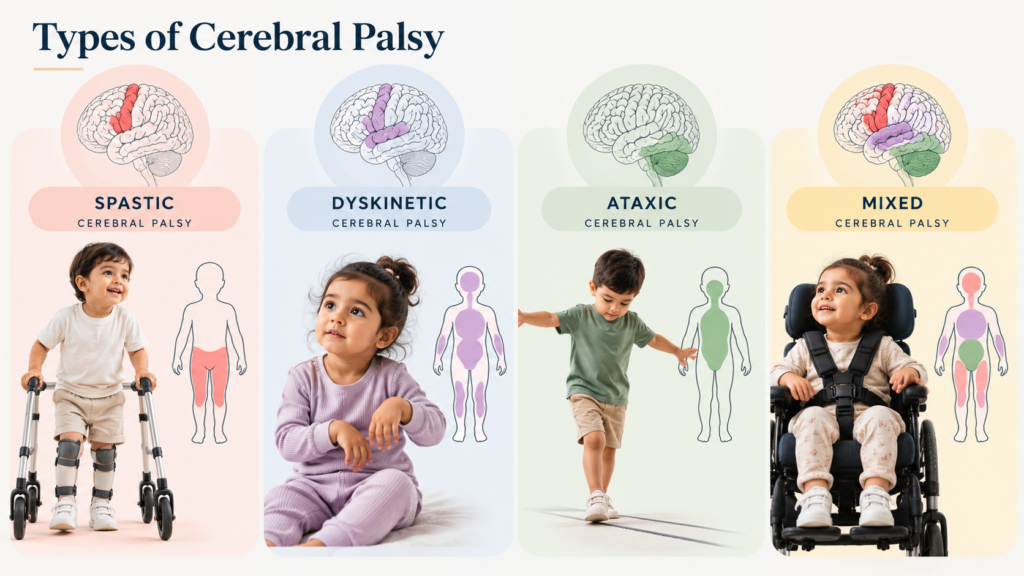
Doctors classify cerebral palsy by the main type of movement problem involved :
- Spastic cerebral palsy is the most common type and affects about 80% of people with CP. Muscles are stiff, which makes movements awkward. It is described by the body parts affected: spastic diplegia (mainly the legs), spastic hemiplegia (one side of the body, usually the arm more than the leg) and spastic quadriplegia (all four limbs, the trunk and the face, the most severe form) .
- Dyskinetic cerebral palsy causes slow, writhing or rapid, jerky movements that a person cannot control. It can make it hard to sit and walk, and the face and tongue may be affected. Muscle tone can change from tight to loose, even within a single day .
- Ataxic cerebral palsy mainly affects balance and coordination. A person may walk unsteadily and find quick or precise movements, such as writing, difficult .
- Mixed cerebral palsy means symptoms of more than one type. The most common mix is spastic-dyskinetic cerebral palsy .
What Causes Cerebral Palsy?
Abnormal brain development or early brain injury can lead to cerebral palsy. This can happen before birth, during birth, within a month after birth, or in the first years of life while the brain is still developing. About 85% to 90% of cases are congenital, meaning the problem began before or during birth. In many cases, the exact cause is never found.
Possible causes include :
- Changes in genes that affect how the brain develops
- Infections in the mother during pregnancy that affect the baby
- Stroke in the developing brain
- Bleeding in the brain
- Infections in a newborn that cause swelling in or around the brain
- Head injury in infancy
- Lack of oxygen to the brain
It was once believed that lack of oxygen during birth was the main cause. Scientists now think it accounts for only a small number of cases .
A small percentage of cerebral palsy is acquired, meaning the damage happens more than 28 days after birth, usually because of an infection such as meningitis or a head injury.
What Are the Risk Factors for Cerebral Palsy?
Certain factors are linked with a higher risk of cerebral palsy. Having a risk factor does not mean a child will develop it, and most children born in these circumstances do not.
- Premature birth and low birth weight: babies born early, or weighing less than about 2.5 kg (5.5 pounds), are at higher risk, and the risk rises the earlier the baby is born.
- Multiple births: twins, triplets and other multiples have a higher risk.
- Infections during pregnancy: these include cytomegalovirus, rubella (German measles), herpes, toxoplasmosis and Zika virus. Fever during pregnancy or delivery can also trigger inflammation that may affect the baby’s brain.
- Exposure to toxins such as methyl mercury during pregnancy.
- Maternal conditions such as thyroid problems, preeclampsia or seizures.
- Illness in a newborn, such as bacterial meningitis, viral encephalitis, or severe jaundice that is prolonged or untreated.
- Complicated labour and delivery, which can sometimes be a sign of a problem that began before birth.
How Is Cerebral Palsy Diagnosed?
Doctors diagnose most children within the first two years. Most children with cerebral palsy are diagnosed in the first two years of life. When symptoms are mild, the diagnosis may not be made until later in childhood.
Diagnosis usually happens in steps:
- Developmental monitoring: tracking the child’s growth and milestones over time.
- Developmental screening: a short test to look for delays in movement and other skills when there is a concern.
- Developmental and medical evaluation: a detailed assessment by specialists to confirm the type of problem, including muscle tone, motor control, posture, coordination, hearing and vision.
The doctor may also recommend tests:
- MRI of the brain, which shows the location and type of brain damage, including changes in the white matter that are typical of cerebral palsy.
- Cranial ultrasound, often used in premature babies at high risk because it is the least intrusive imaging test.
- EEG (electroencephalogram) if seizures are suspected.
- Blood and other tests to rule out other conditions that can look like cerebral palsy.
If a child keeps losing motor skills over time, the cause is likely something other than cerebral palsy, which is why a careful medical evaluation matters.
How Is Cerebral Palsy Treated?
There is no single treatment that suits every child. After diagnosis, a team of health professionals works with the family to build a plan around the child’s needs and goals. This team may include pediatricians, neurologists, surgeons, therapists and other specialists.
Therapies
Therapy is the foundation of treatment:
- Physical therapy uses stretching, resistance and strength-building to maintain or improve muscle strength, balance and movement, and to help prevent contractures.
- Occupational therapy helps children manage daily activities at home, school and in the community.
- Speech and language therapy supports speech, communication and safe swallowing, and can introduce communication aids if needed.
- Recreational therapy encourages sport, art and group activities that build physical and thinking skills.
Medicines
Doctors may prescribe medicines to relax stiff muscles. and ease pain, and they must only be used as prescribed by the child’s doctor. Botulinum toxin injections into specific muscles are often used in spastic cerebral palsy, and the effect lasts about three months. They work best alongside physical therapy and splints. For children with severe, widespread stiffness, an implanted pump can deliver a muscle relaxant (baclofen) directly into the fluid around the spinal cord. The dose can be adjusted as needed.
Surgery
Surgeons may recommend surgery when severe stiffness affects movement. Surgeons can lengthen tight muscles and tendons to improve movement and reduce pain, and operations can also correct or improve spinal deformities. Surgery is usually planned with a team and timed to the child’s age and development, and the benefits and risks should be discussed carefully with the family.
Assistive Devices and Supports
Braces, splints, orthotics, special chairs, walkers and wheelchairs help many children move and sit more comfortably. Communication aids, glasses and hearing aids may also be needed.
Families should discuss any supplements or alternative therapies with their child’s doctor first, because most have not been proven to treat cerebral palsy.
Living With Cerebral Palsy: Long-Term Outlook
Cerebral palsy affects each person differently, so the outlook can be difficult to predict. Many people with cerebral palsy lead active, independent lives with the right support. Over time, some people develop complications such as tight muscles and joint problems, hip or spine changes, feeding and nutrition difficulties, pain, arthritis and low mood. Regular follow-up, continued therapy and emotional support for the child and family make a real difference.
Cerebral Palsy in India: Rights and Support
In India, cerebral palsy is recognized as one of the 21 disabilities listed under the Rights of Persons with Disabilities (RPwD) Act, 2016. The National Trust Act, 1999 also provides for the welfare of persons with cerebral palsy, autism and certain other disabilities. A disability certificate is generally the first step towards accessing government schemes and support, and your doctor can guide you on the certification process.
Can Cerebral Palsy Be Prevented?
Cerebral palsy cannot always be prevented, but some risks can be lowered:
- Get vaccinated against rubella (German measles) before pregnancy.
- Attend regular antenatal check-ups so infections and complications are found and treated early.
- Avoid alcohol, tobacco and illegal drugs during pregnancy.
- Protect young children from head injuries by using car seats, bicycle helmets and bed safety rails, and by supervising them closely.
When Should You See a Doctor?
Speak to your child’s doctor without waiting if your child:
- Is late in reaching milestones such as rolling over, sitting, crawling or walking
- Feels very stiff or very floppy
- Uses one side of the body much more than the other
- Has trouble sucking, feeding or swallowing
- Has seizures or unusual episodes of staring or body stiffening
- Seems to have problems with vision or hearing
These signs do not always mean cerebral palsy, but an early evaluation helps your child start the right therapy sooner. You do not need to wait for a definite diagnosis to begin support.
Get urgent medical help if weakness, face drooping, trouble speaking or other new symptoms appear suddenly in anyone, because they could be signs of stroke.
Frequently Asked Questions About Cerebral Palsy
Is cerebral palsy curable?
No. There is no cure for cerebral palsy, but treatment and therapy can improve a child’s abilities and quality of life, especially when started early.
Does cerebral palsy get worse with age?
The brain condition that causes cerebral palsy does not get worse, and symptoms usually do not worsen with age. However, symptoms can change over a person’s lifetime, and problems such as muscle tightness can worsen if they are not treated.
What is the most common type of cerebral palsy?
Spastic cerebral palsy is the most common type, affecting about 80% of people with the condition.
At what age is cerebral palsy diagnosed?
Most children are diagnosed in the first two years of life, but mild cases may be recognised later in childhood.
Is cerebral palsy a genetic disease?
Cerebral palsy is not usually described as a genetic disorder, although certain genetic factors are thought to increase the risk.
Can adults have cerebral palsy?
Yes. Cerebral palsy is lifelong. Adults may face additional challenges such as pain, fatigue, joint problems and low mood, and they benefit from ongoing medical, physical and emotional support.
Conclusion
Cerebral palsy is a lifelong condition that affects movement, posture and balance, but early recognition and a coordinated treatment plan can help children grow stronger, more independent and more confident. Watching your child’s milestones and speaking up about concerns is the most important step a parent can take.
If you are worried about your child’s movement, muscle tone or development, book a consultation with Dr. Neha Rai to discuss your concerns and the next steps.
This article is for general patient education and does not replace medical advice.
References
- Mayo Clinic. Cerebral palsy: Symptoms and causes. Updated May 1, 2026. https://www.mayoclinic.org/diseases-conditions/cerebral-palsy/symptoms-causes/syc-20353999
- Centers for Disease Control and Prevention. About Cerebral Palsy. Updated June 12, 2026. https://www.cdc.gov/cerebral-palsy/about/index.html
- National Institute of Neurological Disorders and Stroke. Cerebral Palsy. Last reviewed March 13, 2026. https://www.ninds.nih.gov/health-information/disorders/cerebral-palsy
- NHS. Cerebral palsy. https://www.nhs.uk/conditions/cerebral-palsy/
- Wikipedia. Rights of Persons with Disabilities Act, 2016. https://vikaspedia.in/social-welfare/differently-abled-welfare/policies-and-standards/rights-of-persons-with-disabilities-act-2016
- Wikipedia. Acts and Rules (including the National Trust Act, 1999). https://en.vikaspedia.in/social-welfare/differently-abled-welfare/policies-and-standards/acts-and-rules